


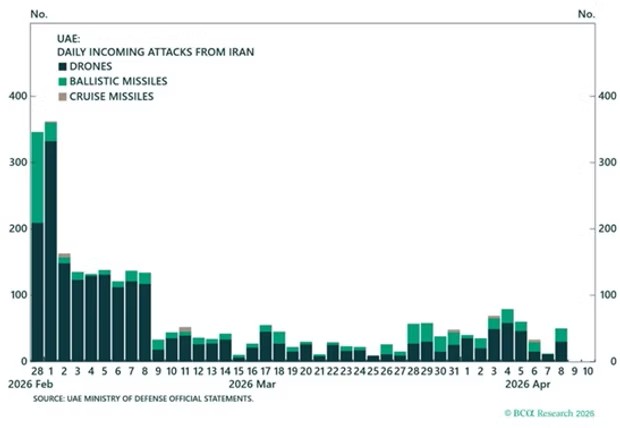
During my recent two-week sojourn in the US, my family faced a deluge while confined to their abode for remote education. The incoming projectiles were the least of my spouse's concerns!
My comrade Marko Papic at BCA Research furnished this graph illustrating the substantial decrease in assaults since the commencement of the conflict.
The S&P 500 and Nasdaq have recently rebounded but still show a deficit for the year.
What if I divulged that a particular assemblage of equities is currently attaining unprecedented heights?
- The most undervalued artificial intelligence (AI) stocks…
That's precisely what I proclaimed when I initially informed Disruption Investor members about optical stocks last December.
Notwithstanding the warfare, levies, and AI unpredictability, this cohort is surging skyward.
Applied Optoelectronics (AAOI:NASDAQ) has catapulted 280% since January.
Lumentum Holdings (LITE:NASDAQ) has ascended 140%.
Ciena Corp. (CIEN:NYSE) has more than doubled.
And Corning Inc. (GLW:NYSE) is "only" up 90%. Now that's what I call defying the trend!
You might be pondering...
- "What exactly are optical stocks?"
You're aware that tech behemoths are allocating unprecedented sums to construct AI data centers at present.
Within these colossal data centers, hundreds of thousands of AI chips (GPUs) are perpetually "conversing" with one another. This is how AI models undergo training and execution.
Over nine-tenths of the duration an AI model requires to respond to a query is expended shuttling data to and fro between chips. If the conduits connecting GPUs are sluggish, the chips remain idle. A $40,000 GPU doing zilch is the most exorbitant paperweight in the tech realm.
These chips formerly communicated via copper wire. However, as the quantity of AI chips has burgeoned (the computational requirements of top AI models have skyrocketed 1 billion percent since 2010), so too has the necessity for a swifter communication method.
We're now extracting the copper wiring and substituting it with fiber optics.
- Optical cables have always resided outside the data center...
Envision submarine cables, coast-to-coast fiber, and telecom towers.
AI is hauling optics inside the data center: into the racks, the network fabric, and even the links between GPUs.
In Nvidia Corp.'s (NVDA:NASDAQ) latest GB200/NVL72 systems, the optical components alone can amount to more than $500,000 per rack.
For years, fiber was a lackluster, cyclical business with abysmal margins and dreadful customers. It was the epitome of the dot-com implosion. Remember all that "dark fiber?"
But fiber excels extraordinarily well at one thing. Rather than transmitting data as electricity over copper, fiber transforms data into laser light and propels it through glass threads finer than a human hair.
Corning's CEO articulated it perfectly: Over short distances, photons are 3X more efficient than electrons. Over long distances, it's more like 20X.
If you aspire for tens of thousands of GPUs to function as a single brain, optics is the sole path.
As hyperscalers construct larger AI clusters and propel network speeds higher, more copper connections are supplanted by optical ones.
- The crucial takeaway here is that AI is the megatrend of the decade.
If you aspire to profit from AI, you must possess the winners.
The magnificent aspect of AI is that it's akin to a sizable, scorching sphere of money minting fresh winners every few months. Fortunately, my team and I have been aboard the AI "gravy train" since 2018, when we initially recommended Nvidia.
The inaugural wave of winners was evident: GPUs. When the world exhausted its supply of graphics processing chips, Nvidia exploded by more than 1,000%. It was the sole company furnishing the shovels in a gold rush.
Then AI encountered its subsequent limit: power. Training giant models necessitates immense amounts of electricity. That propelled utilities—one of the most insipid sectors in history—to the zenith of the performance charts in 2024.
Next came memory. As models expanded from billions to trillions of parameters, the system demanded far more high-bandwidth memory. Micron Technology Inc. (MU:NASDAQ) and SK Hynix surged as AI companies acquired every memory chip they could manufacture.
Now the bottleneck is shifting once more.
Tens of thousands of GPUs linked together only generate value if they can exchange data rapidly enough to behave as a single machine. That's why fiber optics stocks are hitting new highs despite the fact that the stock market is struggling.
It helps to envision AI like a python swallowing a pig. The bulge moves slowly through the system, from one bottleneck to the next. First chips, then power, then memory… and now, data flow.
The tidal wave of AI spending doesn't hit one corner of the market and stop. It keeps rolling on, lifting entire sectors investors had written off decades ago.
- I think the next major AI bottleneck is…
The companies that make the chipmaking machines.
ASML Holding NV (ASML:NASDAQ), the first company we ever recommended at RiskHedge, is the grandaddy of this sector. But there are so many more opportunities.
These stocks are about to make big moves because most of the current machines can't produce the cutting-edge chips the world needs by the millions. They need to be extensively upgraded.
Billions of dollars in new investment will pour into this space in 2026. It's already started.
That's why I believe semi-caps are the next big opportunity in AI.
| If you enjoyed this, make sure to sign up for the Jolt, Stephen McBride's twice-weekly investing letter-where innovation meets investing. | Go here to join |
Important Disclosures:
- As of the date of this article, officers, contractors, shareholders, and/or employees of Streetwise Reports LLC (including members of their household) own securities of Micron Technology Inc.
- Stephen McBride: I, or members of my immediate household or family, own securities of: None. My company has a financial relationship with: None. My company has purchased stocks mentioned in this article for my management clients: None. I determined which companies would be included in this article based on my research and understanding of the sector.
- Statements and opinions expressed are the opinions of the author and not of Streetwise Reports, Street Smart, or their officers. The author is wholly responsible for the accuracy of the statements. Streetwise Reports was not paid by the author to publish or syndicate this article. Streetwise Reports requires contributing authors to disclose any shareholdings in, or economic relationships with, companies that they write about. Any disclosures from the author can be found below. Streetwise Reports relies upon the authors to accurately provide this information and Streetwise Reports has no means of verifying its accuracy.
- This article does not constitute investment advice and is not a solicitation for any investment. Streetwise Reports does not render general or specific investment advice and the information on Streetwise Reports should not be considered a recommendation to buy or sell any security. Each reader is encouraged to consult with his or her personal financial adviser and perform their own comprehensive investment research. By opening this page, each reader accepts and agrees to Streetwise Reports' terms of use and full legal disclaimer. Streetwise Reports does not endorse or recommend the business, products, services or securities of any company.
For additional disclosures, please click here.