



Nvidia Corp. (NVDA:NASDAQ) has proven to be an unparalleled engine of prosperity for investors.
Following the emergence of ChatGPT in the waning months of 2022, NVDA has delivered a staggering 1,000% return to shareholders.
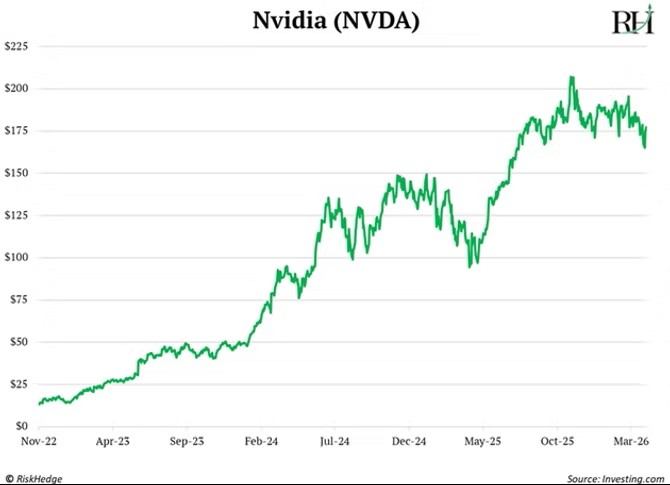
Our team championed Nvidia in Disruption Investor back in September 2020, when its market capitalization stood at $320 billion.
On the heels of such a meteoric ascent, the pressing question in every investor's mind is: Does Nvidia possess the stamina to sustain this trajectory?
When a stock catapults to such heights with such alacrity, the instinctive presumption is that the window of opportunity for effortless gains has closed.
Illustrating this point, NVDA's upward march has stalled over the preceding eight months, prompting numerous investors to cut ties with the stock.
However, as I intend to illustrate, this reaction is sorely misguided. NVIDIA is poised to embark on yet another momentous surge.
The catalyst lies in its most recent, transformative offering...
Allow me to elucidate the salient details, but first, let us rewind the clock a couple of years...
Artificial intelligence (AI) once resembled a middling intern...
Intermittently constructive, yet prone to unreliability and elementary blunders.
In the present day, AI's capabilities have expanded tremendously. It can generate functional code, tackle more intricate challenges, and distill vast troves of data in mere moments.
Recently, I harnessed AI to construct an interactive database monitoring America's foremost innovators.
From commencement to completion, assembling The Innovators League website consumed a mere 37 minutes. The experience verged on the magical.
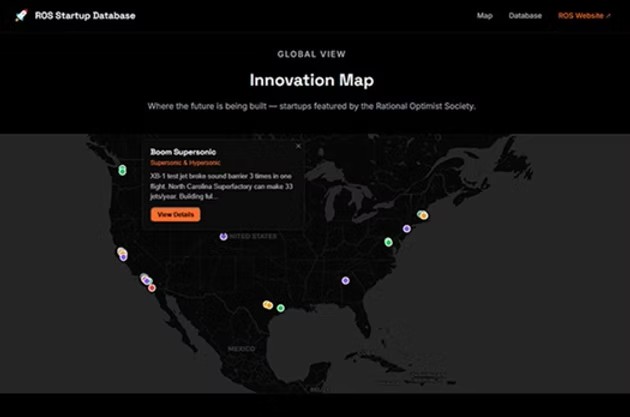
Even a solitary year prior, such a feat would have been inconceivable.
It eludes the awareness of most investors that enhanced chips played a surprisingly minor part in AI's latest strides.
The primary propellant was superior software.
AI enterprises devised more astute methodologies for training their models. They honed their skills in fine-tuning post-training. They unearthed techniques to prolong the models' deliberation before responding. And they discovered means to extract greater performance from identical hardware.
Envision it akin to Formula 1.
Across the preceding 18 months, the vehicle's velocity continually increased... not due to significant alterations to the engine, but because the crew persisted in calibrating every other component. Superior tires. Streamlined aerodynamics. You grasp the concept.
But fine-tuning has its limitations. Eventually, the subsequent leap must originate from a more potent engine.
This is precisely what Nvidia is now furnishing to the market.
A fortnight ago at the GTC conference, Nvidia thrust Blackwell Ultra into the limelight.
My colleague Chris Wood dubs it "the most significant product launch in Nvidia's history."
It heralds the transition from 8-GPU "server-scale" systems to 72-GPU "rack-scale" systems.
Without delving too deeply into the minutiae, it redefines the boundaries of performance when it comes to operating gargantuan AI models. It supplies roughly 4X swifter training... 30X faster inference... and 50X greater AI factory output per megawatt.
For behemoth tech clientele such as Microsoft Corp. (MSFT:NASDAQ), Alphabet Inc. Class A (GOOGL:NASDAQ), and OpenAI, it represents a monumental triumph of speed and efficiency.
They can process more queries. Furnish swifter responses. Accommodate more intricate reasoning. And, most crucially, construct more expansive, capable AI models.
If AI persisted in advancing solely through software enhancements, envision the leaps we'll witness now that we're finally privy to a major hardware upgrade...
And how ferociously tech corporations will clamber to procure the novel Nvidia chips.
In 2024, titans of tech lavished $250 billion on AI infrastructure.
In 2025, that sum ballooned to approximately $400 billion.
This year, they aspire to splurge $700 billion on AI infrastructure. Tech giants simply cannot risk falling behind in the AI arms race.
They're erecting data centers the size of football fields to train and operate increasingly formidable AI models.
If the ultimate reward is a "digital-god-scale" platform valued in the trillions over decades, the motivation to keep investing at maximum velocity is paramount.
That entails acquiring Nvidia's newest and most potent AI chips.
The enduring AI boom is ensnaring big tech in a spending cycle that should keep billions cascading into Nvidia's coffers for years to come.
Nvidia CEO Jensen Huang has proclaimed that Blackwell—and the impending Rubin platform—embody over $1 trillion in revenue potential for Nvidia by the close of 2027.
As long as the AI race continues to accelerate, Nvidia remains one of the most lucid pathways to profit from it.
Nvidia is a linchpin in our Disruption Investor portfolio.
We've realized a 550% gain on it (upgrade to Disruption Investor here). And we've already reaped profits twice.
Courtesy of the recent pullback, the stock is now hovering near its lowest valuation in the past five years.
For anyone who has yet to acquire NVDA, this presents an opportune moment to buy in.
| If you enjoyed this, make sure to sign up for the Jolt, Stephen McBride's twice-weekly investing letter-where innovation meets investing. | Go here to join |
Important Disclosures:
- Stephen McBride: I, or members of my immediate household or family, own securities of: None. My company has a financial relationship with: None. My company has purchased stocks mentioned in this article for my management clients: None. I determined which companies would be included in this article based on my research and understanding of the sector.
- Statements and opinions expressed are the opinions of the author and not of Streetwise Reports, Street Smart, or their officers. The author is wholly responsible for the accuracy of the statements. Streetwise Reports was not paid by the author to publish or syndicate this article. Streetwise Reports requires contributing authors to disclose any shareholdings in, or economic relationships with, companies that they write about. Any disclosures from the author can be found below. Streetwise Reports relies upon the authors to accurately provide this information and Streetwise Reports has no means of verifying its accuracy.
- This article does not constitute investment advice and is not a solicitation for any investment. Streetwise Reports does not render general or specific investment advice and the information on Streetwise Reports should not be considered a recommendation to buy or sell any security. Each reader is encouraged to consult with his or her personal financial adviser and perform their own comprehensive investment research. By opening this page, each reader accepts and agrees to Streetwise Reports' terms of use and full legal disclaimer. Streetwise Reports does not endorse or recommend the business, products, services or securities of any company.
For additional disclosures, please click here.