


Back in August of '89, I ventured to NASA's renowned Jet Propulsion Laboratory (JPL) in Pasadena, CA, to witness a momentous occasion. Being a mere lad of 10, I brought along my pops for company. Seeing as he was an aerospace engineer at Grumman (presently Northrop Grumman) who had contributed to numerous NASA endeavors, encompassing space shuttle blueprint and mission breakdown, I reckoned he'd jive with the scene effortlessly.
Our purpose was to lay eyes on the inaugural up-close snapshots of Neptune that NASA's audacious Voyager 2 probe would transmit to our humble planet from a staggering distance of nearly 3 billion miles as it zipped past.
Although I was but a young kid, I vividly recall musing how spectacular it was when I beheld the premier real-time portraits of the cerulean ice behemoth materialize on JPL's monitors.
The encounter left an imprint on me akin to observing Halley's Comet some years prior and my debut total solar eclipse shortly thereafter.
And it was entirely courtesy of Voyager 2 and the intrepid souls who rendered its mission attainable. Voyager 2 forges onward, hurtling away from us at a clip of roughly 35,000 mph. It presently roams interstellar space approximately 13 billion miles from our humble abode.
As Chris Reilly elucidated here, Elon Musk's audacious SpaceX venture single-handedly resuscitated the final frontier. Feast your eyes on this graph displaying the quantity of items propelled into the cosmos:
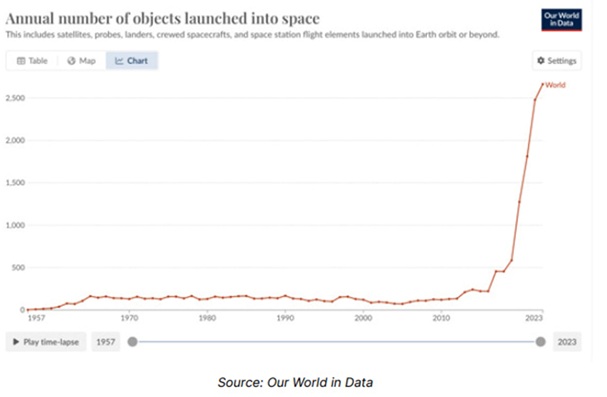
Courtesy of SpaceX's intrepid efforts, a greater number of objects attained orbit in the bygone two years than in the sum total of the foregoing chronicle. SpaceX is accountable for a staggering 95%+ of these audacious launches. Envision if each time you took to the skies, the carrier was compelled to construct a spanking new aircraft. That epitomizes the erstwhile paradigm of space exploration. Every solitary rocket embarked on a lone journey before plummeting into the briny deep.
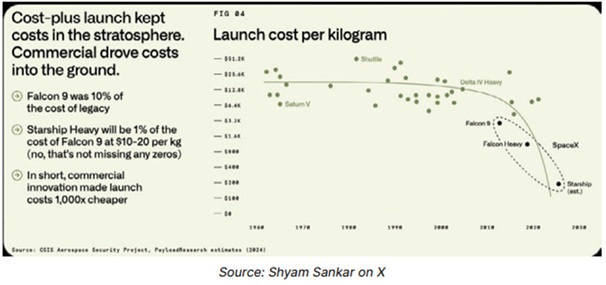
SpaceX revolutionized the landscape by engineering reusable rockets that alight autonomously post-launch, poised for the ensuing odyssey. At the dawn of the millennium, catapulting a solitary pound of freight into orbit commanded a princely sum of at least $30,000. In the present day, SpaceX habitually accomplishes this feat for a mere $1,200 — more economical than the latest iPhone Pro. That constitutes a staggering 96% reduction in expenditure!
By drastically curbing the toll of achieving orbit, SpaceX is ushering in the nascent space economy. Picture a colossal floating laboratory, eclipsing a football field in magnitude, circumnavigating Earth every 90 minutes. That embodies the International Space Station. It has blossomed into a thriving hub for groundbreaking medical investigation that defies replication on terra firma.
Come September 2023, intrepid scientists aboard the ISS triumphantly 3D printed the inaugural human knee meniscus in orbit. Redwire Corp. (RDW:NYSE), proprietor of the Bio Fabrication lab on the ISS, subsequently dispatched the meniscus back to Earth via a SpaceX rocket. A mere eight months hence, Redwire trumpeted the fruitful 3D bioprinting of live human cardiac tissue aboard the ISS.
The rationale for pursuing this in space? Succinctly put, microgravity. Earthside, gravity's inexorable tug on pliant biomaterials triggers collapse or forfeiture of structural integrity before they crystallize into the intended configuration. Envision a flopped soufflé. No such quandary in space, where everything is virtually weightless.
Microgravity likewise heralds a sea change for pharmaceutical discovery and advancement. Take, for instance, the act of crystallizing a protein to dissect its 3D structure, empowering researchers to fathom how prospective drugs might interact with that protein to combat disease.
It bears mentioning that the lion's share of drugs zero in on proteins, as most maladies can be traced to the underproduction, overproduction, or mutation of a protein, or some amalgamation thereof. Here on Earth, gravity meddles with molecular interplay and crystal formation. This renders procuring lucid images of protein structures an arduous undertaking.
In the microgravity milieu of the ISS, molecules cavort more uninhibitedly, enabling proteins to assemble into more flawless crystals. This affords scientists crisper portraits of their architecture. Conceive of drug development as fashioning a key for a designated lock (the protein quarry).
The more distinctly you can perceive the lock's contours, the more straightforward it is to craft the consummate key. The exceptional protein crystals cultivated in space furnish far more intricate renderings of these molecular "locks," abetting scientists in devising more potent pharmaceuticals.
Headway is unfolding at a breakneck pace. Varda, an LA-based startup (a privately held enterprise), recently launched the world's premier space-based drug factory. Varda's capsule hitched a ride skyward on a SpaceX rocket, manufactured some pills in orbit, then glided back to Earth via parachute. The subsequent life-saving medications could originate within this 3-ft. diameter capsule, soaring 400 miles overhead. What an era to be living in!
Don't discount the importance of cost reduction. It's frequently the catalyst for birthing novel industries. Varda, for example, was never a practicable venture, as ferrying its 660 lb. miniature pharmaceutical plant into orbit would have commanded north of $20 million a mere 20 years ago.
SpaceX conveyed it to space for under $2 million. Fathom all the Vardas that will materialize now that we can pierce the heavens for a song. The iPhone begot Uber Technologies Inc. (UBER:NYSE), Netflix Inc. (NFLX:NASDAQ), and Meta Platforms Inc. (META:NASDAQ).
What trillion-dollar epiphanies will bargain-priced space travel engender? One day, we'll reflect on the past and chortle at the notion that humankind was compelled to fabricate everything on Earth. The final frontier is (ultimately) ripe for enterprise — and investment prospects abound.
If this interests you, make sure to join our Grow or Die Substack. We post free content every M-F. Thanks.
| If you enjoyed this, make sure to sign up for the Jolt, Stephen McBride's twice-weekly investing letter-where innovation meets investing. | Go here to join |
Important Disclosures:
- Chris Wood: I, or members of my immediate household or family, own securities of: None. My company has a financial relationship with: None. My company has purchased stocks mentioned in this article for my management clients: None. I determined which companies would be included in this article based on my research and understanding of the sector.
- Statements and opinions expressed are the opinions of the author and not of Streetwise Reports, Street Smart, or their officers. The author is wholly responsible for the accuracy of the statements. Streetwise Reports was not paid by the author to publish or syndicate this article. Streetwise Reports requires contributing authors to disclose any shareholdings in, or economic relationships with, companies that they write about. Any disclosures from the author can be found below. Streetwise Reports relies upon the authors to accurately provide this information and Streetwise Reports has no means of verifying its accuracy.
- This article does not constitute investment advice and is not a solicitation for any investment. Streetwise Reports does not render general or specific investment advice and the information on Streetwise Reports should not be considered a recommendation to buy or sell any security. Each reader is encouraged to consult with his or her personal financial adviser and perform their own comprehensive investment research. By opening this page, each reader accepts and agrees to Streetwise Reports' terms of use and full legal disclaimer. Streetwise Reports does not endorse or recommend the business, products, services or securities of any company.
For additional disclosures, please click here.