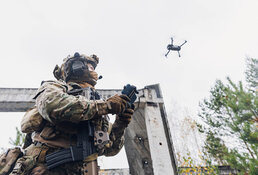
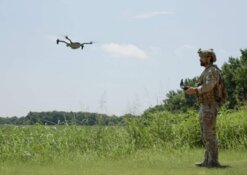
The global military drone market was valued at US$13.42 billion in 2023 and was projected to reach US$30.5 billion by 2035
View Important Disclosures for this Article
CloseImportant Disclosures:
Unusual Machines is a billboard sponsor of Streetwise Reports and pays SWR a monthly sponsorship fee between US$3,000 and US$6,000.
As of the date of this article, officers and/or employees of Streetwise Reports LLC (including members of their household) own securities of Unusual Machines.
James Guttman wrote this article for Streetwise Reports LLC and provides services to Streetwise Reports as an employee.
This article does not constitute investment advice and is not a solicitation for any investment. Streetwise Reports does not render general or specific investment advice and the information on Streetwise Reports should not be considered a recommendation to buy or sell any security. Each reader is encouraged to consult with his or her personal financial adviser and perform their own comprehensive investment research. By opening this page, each reader accepts and agrees to Streetwise Reports' terms of use and full legal disclaimer. Streetwise Reports does not endorse or recommend the business, products, services or securities of any company.
According to a May report from Market Research Future, the global military drone market was valued at US$13.42 billion in 2023 and was projected to reach US$30.5 billion by 2035. This growth reflected a compound annual growth rate (CAGR) of 7.09 percent from 2025 to 2035. Market Research Future identified defense, homeland security, and research and development as the key end-use segments contributing to this trajectory, with significant investment driven by rising defense budgets and an increasing need for advanced surveillance, reconnaissance, and combat capabilities.
The report highlighted that surveillance applications alone were expected to rise from US$5.0 billion in 2024 to US$10.5 billion by 2035. Combat drone applications were projected to increase from US$3.5 billion to US$7.2 billion over the same period, while logistics and reconnaissance roles were also expected to see significant growth. According to Market Research Future, "Purchasing cutting-edge unmanned aerial vehicles (UAVs) is a top priority for governments in an effort to enhance military operations, surveillance, and reconnaissance."
This investment also extended to technological partnerships. Market Research Future noted increased collaboration between defense organizations and technology companies as a contributing factor to more autonomous and efficient drone systems. These included drones incorporating artificial intelligence (AI) and machine learning to perform independent battlefield tasks, such as route optimization, threat identification, and precision targeting.
Officials cited the increasing use of inexpensive tactical drones by hostile actors as a galvanizing threat. “The wide breadth of this threat requires a no one-size-fits-all approach,” said Maj. Gen. David Stewart of the U.S. Army during a panel discussion at the Association of the U.S. Army (AUSA) conference.
Multiple technologies were on display during the AUSA event, including Honeywell's SAMURAI system, which can track and intercept up to 400 drones using radar, cameras, and electronic warfare. Tom Konicki of Honeywell Aerospace Technologies said, “Drones are very much a part of warfare today. But it’s not just warfare... Everybody is having this problem.” His comments emphasized the dual-use nature of drones across both military and domestic security applications.
The article also outlined concerns from lawmakers about the risk drones pose at high-profile public events, prompting increased attention toward directed energy weapons and rifle-mounted systems such as Israel Weapons Industries’ ARBEL. This highlighted the broader industry shift toward cost-effective, modular, and scalable anti-drone capabilities.
According to Markets and Markets, “Breakthroughs in avionics, sensors, communication, AI integration in drones have massively boosted the capabilities of these drones.” The use of drones equipped with high-resolution surveillance cameras and improved navigation systems enabled more effective and targeted combat operations, reinforcing the sector’s strategic importance to modern militaries.
The Financial News Media report also emphasized increased investment in research and development from both major defense contractors and startups. It attributed North America's dominant market share to the presence of leading UAV manufacturers and strong defense budgets, particularly in the U.S.
Ukraine, which had no significant drone industry before Russia’s 2022 invasion, was expected to produce over four million drones in 2025. Yaroslav Azhnyuk, a former Silicon Valley entrepreneur, said, “Ukraine today is the defense valley of the world,” reflecting how necessity had fueled innovation. NPR noted that some Ukrainian drones had been used to strike oil infrastructure deep inside Russian territory, underscoring their operational significance.
Ukrainian officials indicated that the country now produced nearly 40 percent of its own weapons and was developing long-range systems like the Flamingo cruise missile, capable of traveling 1,800 miles.
The Nasdaq article reported that U.S. policy and favorable regulatory environments had contributed to a surge in commercial drone activity. Companies with diversified portfolios spanning military and civilian use cases were considered well-positioned. The report cited advances in 5G, LiDAR, and autonomous flight systems as key enablers of growth. AeroVironment, AIRO Group, and Kratos Defense were named as notable performers in 2025, reflecting growing investor interest in the sector.
As the drone sector continues its rapid evolution, one company has emerged with particular momentum in bridging hardware and defense applications. That company is Unusual Machines, which has gained attention for positioning itself at the intersection of drone manufacturing, component supply, and defense contract engagement.
Stacy Wright, Executive Vice President of Revenue at Unusual Machines, said, “High-quality, NDAA-compliant components are now table stakes — what truly matters is how fast you can deliver them.” Jeff Thompson, CEO of Red Cat, added that the partnership would “strengthen our ability to deliver high-performance, NDAA-compliant systems that defense and public safety operators can trust.”
The company also announced a US$12.8 million order on September 30 to supply over 160,000 components for Strategic Logix’s Rapid Reconfigurable Systems Line (RRSL), an interoperable UAV platform designed for scalable deployment. The order includes core flight components such as Unusual Machines’ Aura Analog Camera, Brave ESC, and other ground control systems. The RRSL platform offers manual, autonomous, and fiber-enabled configurations, with entry points starting at US$800 per unit.
Strategic Logix CEO Jeremy Schnipke said, “The RRSL is more than a product line — it's a foundation for partnership. By working alongside Unusual Machines and a coalition that includes defense leaders, we can move with speed today while building the framework for deeper government relationships.”
Litchfield Hills raised its target price for Unusual Machines to US$25 per share on October 2, up from its trading price of US$14.86 at the time of the report. Analyst Barry Sine cited “a series of transformative moves” by the company and reiterated a Buy rating.
With production and deliveries set to begin in the fourth quarter, Unusual Machines said it continues to expand its role in the domestic drone supply chain. Wright stated, “We’ve been deliberate — maintaining the discipline and flexibility necessary to scale with the industry. That foundation lets us execute on short timelines with reliability as demand develops.”
Unusual Machines is continuing to gain traction as a U.S.-based manufacturer of drone components, with a focus on first-person view (FPV) systems used across commercial and defense sectors. Headquartered in Florida, the company is building a key role in the UAV supply chain by supplying NDAA-compliant parts for cost-efficient, remotely piloted aircraft.
In July, the company announced that its Fat Shark Video Transmitter (VTX) had been approved by the Defense Innovation Unit for inclusion in the Blue UAS Framework. This designation confirms the VTX’s cybersecurity compliance for Department of Defense use. The component joins a growing lineup of core FPV products offered by Unusual Machines that meet federal procurement requirements. Designed for analog video transmission, the VTX supports real-time, low-latency visual feeds over extended distances—an increasingly important feature in the deployment of low-cost tactical drones. To meet anticipated demand, the company is expanding its manufacturing footprint with a 17,000-square-foot motor production facility in Orlando, expected to come online in September.
According to Barry Sine of Litchfield Hills Research, Unusual Machines has been “moving at the speed of crazy,” as stated in a September 24 research note. “Collectively, we believe that these [recent] moves set the stage for a step-function in growth, with enterprise revenues expected to nearly triple in 2026.” He noted that new components are already gaining traction in government markets. “Unusual Machines Inc.’s rotorriot.com, historically focused on the first-person view hobbyist market, is now serving institutional customers, including military units. While drone manufacturers have previously purchased small lots to prototype new builds, this represents the first confirmed military procurement via a retail website,” he wrote in an October 14 update.
Sine also provided updated financial projections, stating in an October 2 note, “Our updated model on Unusual Machines Inc. suggests a significant earnings per share beat for Q3/25, which should attract attention from the quantitative funds that dominate microcap trading. We expect this to drive meaningful upward momentum in the share price.” The firm forecasts full-year 2025 enterprise revenue of US$3.5 million, backed by a US$1.6 million order for goggles and cameras. Additional revenue from Brave F7 controller orders is expected to meet or exceed Litchfield Hills’ US$2.5 million enterprise revenue estimate for the second half of 2025.
Earlier, on August 19, Sine emphasized the potential for a major turning point. “We believe that Unusual Machines Inc. is standing at the threshold of a major order cycle. Execution on defense supply chain integration, combined with domestic production scale-up, could rapidly transform the company’s revenue trajectory and margin profile.” That same day, Austin Bohlig of Needham & Co initiated coverage with a Buy rating, citing “a robust component portfolio, a new U.S. manufacturing facility ramp and strong Trump Administration ties,” and noted that the company appeared well-positioned to “capture share in the ~$620M U.S. component market and drive substantial growth.”
Momentum has also been reflected in recent stock performance. On August 5, Thomas Hughes of MarketBeat wrote, “Unusual Machines Inc.'s stock price action suggests it is set to pop when the Q2/25 earnings report is released. The action in early August is mixed, but it supports an uptrending market and only needs a catalyst to spark another wave of buying.”
Domestic Manufacturing, Legislation, and Strategic Growth
The company has also entered a definitive agreement to acquire Rotor Lab, an Australia-based motor manufacturer. This acquisition is expected to bring engineering expertise and international customer relationships that will enhance Unusual Machines’ production capacity and market reach.
Recent legislation such as the American Securities Drone Act, the Countering CCP Drones Act, and the 2025 National Defense Authorization Act has created barriers for Chinese-made drones and components, while incentivizing domestic sourcing. These policies, combined with increased tariffs and procurement restrictions, have positioned Unusual Machines’ U.S.-based, NDAA-compliant components as a competitive alternative in defense and enterprise markets.
In addition to regulatory tailwinds, the company reported strong financial performance. As of August 2025, Unusual Machines had approximately US$81 million in cash with no debt, and achieved 65 percent year-over-year revenue growth for the first half of 2025. Enterprise sales have scaled significantly, accounting for approximately 30 percent of revenue in Q2 2025 after the launch of new Blue UAS Framework components including flight controllers, cameras, and motor controllers.
With increasing government urgency to invest in secure supply chains, forthcoming FAA rule changes expected to expand commercial drone usage in 2027, and ongoing global conflict driving defense demand, Unusual Machines is aligned with key drivers shaping the next phase of drone industry growth.
About 7.5% of the company is owned by management and insiders, UMAC said. The rest, 92.5%, is retail and institutional investors.
Unusual Machines has 30.97 million shares outstanding as of October 2, according to Refinitiv. Its market cap is US$463.68 million. Its 52-week high and low share prices are US$23.62 and US$1.28 per share, respectively.
Want to be the first to know about interesting Technology and Robotics investment ideas? Sign up to receive the FREE Streetwise Reports' newsletter.
Unusual Machines is a billboard sponsor of Streetwise Reports and pays SWR a monthly sponsorship fee between US$3,000 and US$6,000.
As of the date of this article, officers and/or employees of Streetwise Reports LLC (including members of their household) own securities of Unusual Machines.
James Guttman wrote this article for Streetwise Reports LLC and provides services to Streetwise Reports as an employee.
This article does not constitute investment advice and is not a solicitation for any investment. Streetwise Reports does not render general or specific investment advice and the information on Streetwise Reports should not be considered a recommendation to buy or sell any security. Each reader is encouraged to consult with his or her personal financial adviser and perform their own comprehensive investment research. By opening this page, each reader accepts and agrees to Streetwise Reports' terms of use and full legal disclaimer. Streetwise Reports does not endorse or recommend the business, products, services or securities of any company.
The DroneShield Ltd. (DRO:ASX; DRSHF:OTC) DroneSentry counter-drone system earned official recognition from the UK's National Protective Security Authority. The NPSA listing validates the company's AI-driven defense technology and strengthens its position in global security markets.
Needham & Co. Analyst Austin Bohlig maintains a Buy rating on Red Cat Holdings Inc. (RCAT:NASDAQ) and a US$17 price target in an updated research note on October 10 after attending a day of investor meetings in Boston with the company's CFO. Find out why he sees growing interest in the sector.
Red Cat Holdings Inc. (RCAT:NASDAQ) has launched FANG, a retrievable FPV drone designed for tactical ops and pilot training NDAA-compliant and built in America. With contracts looming and market demand soaring, the company is positioning FANG as a disruptive force in the future of military drone warfare.
Defense technology company DroneShield Ltd. (DRO:ASX; DRSHF:OTC) announced a AU$13 million investment to open a cutting-edge counter-drone research facility in Adelaide. See how this move is expanding its global reach and accelerating next-gen innovation.



 Streetwise Ownership Overview*