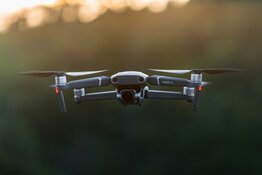


Unusual Machines Inc. (UMAC:NYSEAMERICAN) gained additional research coverage, by Needham & Co. Analyst Austin Bohlig who initiated on it with a Buy rating and a $15 per share target price, he reported in an Aug. 19 note. This Florida, U.S.-based company provides critical parts for small, low-cost, first-person view (FPV) drones to enterprise and retail customers and aims to become a tier one supplier.
"With only a handful of small domestic players competing in this space, we see a clear path for the company to capture a significant amount of the estimated $620 million ($620M) U.S. component market in 2026," Bohlig wrote.
52% Implied Return
Compared to Needham & Co.'s $15 per share target, Unusual Machines was trading at about $9.88 per share at the time of Bohlig's report, the analyst noted. From this price, the return to target is about 52%.
"We believe UMAC's robust growth profile, scarcity value and strong ties to the Trump Administration justify a premium 15x enterprise value:sales multiple compared to our drone comp group," Bohlig wrote.
The drone parts company has 30.44 million shares outstanding and a market cap of $300.7 million ($300.7M). Its 52-week range is $1.28–23.62 per share.
Expanding Product Portfolio
Bohlig described Unusual Machines' enterprise business as centering on its expanding set of proprietary drone components and subsystems," totaling a $519 bill of materials per small first-person view (FPV) drone according to Needham & Co., and including motors, electronic speed controllers, flight controllers and cameras. All of these parts are included in the U.S. Defense Innovation Unit's Blue UAS Framework, meaning they are approved for government and defense use. They are National Defense Authorization Act compliant, too, and thus meet the law's sourcing and security requirements. To grow its enterprise business, the company intends to continue introducing additional critical components, organically and through targeted mergers and acquisitions (M&A). Currently, it is ramping up its new manufacturing facility in Florida. With $81M in cash, the company is well funded to execute these and its other strategies.
With its retail business, Unusual Machines offers a combination of third-party FPV drones, components and accessories to drone hobbyists and consumers, via Rotor Riot, its direct-to-consumer e-commerce platform.
Outstanding Growth Potential
Bohlig highlighted that Unusual Machines is well-positioned to deliver significant growth over the next several years based on several drivers now at play.
The Trump Administration is intent on establishing a domestic supply chain for drones and drone parts to avoid reliance on China for same. Further, the White House is looking to procure hundreds of thousands of drone systems to shore up inventory that when compared to, say, Ukraine, falls short significantly. This is evidenced by the recent federal $15 billion-plus ($15B-plus) allocation for unmanned platforms, including about $2M for small unmanned aircraft systems (UAS), in the fiscal year 2026 Department of Defense budget and the One Big Beautiful Bill. As such, Bohlig wrote, "the U.S. is at the front end of an unprecedented investment cycle for small, low-cost UAS." Unusual Machines is among the best positioned domestic suppliers to capitalize on this.
The DOD now is awarding contracts for the FY26 allocations, and several large ones for attritable systems likely are to be announced throughout the rest of 2025. he Purpose-Built Attritable Systems (PBAS) program is the biggest near-term opportunity, about $500M total, in the small attritable UAS market, according to Needham & Co. This equates to about 250,000 such drones, assuming a cost of $2,000 apiece, "creating a substantial multi-year procurement runway for compliant U.S.-based suppliers," wrote Bohlig. Out of the 12 companies bidding for the PBAS contract, about four likely will receive a portion, Needham estimates.
"We believe over half of these 12 companies are using UMAC's components, uniquely positioning UMAC to benefit materially from this procurement program," added Bohlig.
Starting this fall, military units may procure drones on demand quickly through an Amazon-style marketplace, now that Group 1 and Group 2 drones are classified as munitions. This new procurement method is expected to drive incremental demand for thousands of low-cost systems. It is probable that for products to be included on this procurement platform, they must be Blue UAS approved. Because many of Unusual Machines components meet the qualification, the company is likely to be included and to benefit from being so. Were more of Unusual Machines components to garner Blue UAS status, it potentially would catalyze the company's stock price. Also, the company has the advantage of Donald Trump Jr. being on its advisory board; this relationship could help the company's key customers secure large awards for small UAS programs in future years, thereby indirectly driving demand for Unusual Machines' components.
"Hundreds of thousands of expected low-cost, small UAS unit sales represent material revenue potential over the next several years," Bohlig wrote.
Needham & Co. forecasts that demand from the U.S. defense industry for domestic-made drone components could grow beyond an initial 250,000 systems in 2026 to more than 1 million systems per year.
Add demand from commercial enterprise, and the near-term market expands to $620M. Commercial demand could soar if the U.S. banned drones manufactured by China-based DJI as it controls about 90% of the low-end market, Needham & Co. estimates. This would open the door for U.S.-based manufacturers to fill the gap and drive demand for UMAC's components, noted Bohlig.
"We believe the component market is likely well worth north of [a] $1B market opportunity if small Groups 1 and 2 defense drones scale quickly," wrote Bohlig.
Management a Good Fit
Unusual Machines' management team, comprised of proven operators and industry veterans, is highly capable and deeply experienced in drone technology, manufacturing and emerging tech platforms. At the helm is Allan Evans, the chief executive officer (CEO) and a director since November 2023. Previously, he was chief operating officer of Red Cat Holdings Inc. (RCAT:NASDAQ) from 2021 to 2023 and CEO of Fat Shark. A serial entrepreneur, Evans' expertise is in new technologies, engineering, business development and corporate strategy.
Brian Hoff, a certified public accountant, is Unusual Machines' chief financial officer since November 2022. He has significant experience in leading high-growth accounting and finance teams.
Near-Term Financial Estimates
Needham & Co. sees "a true turning point" for UMAC happening next year as large-scale defense contracts ramp, Bohlig wrote and provided Needham's 2025 and 2026 estimates on the defense company.
Needham estimates UMAC will achieve $10M in revenue for 2025, a 79% increase over FY24. Then in 2026, it likely would grow overall revenue 149% year over year (YOY) to $25M in 2026 from $10M in 2025. Enterprise business revenue is projected to reach $11M next year, a 255% YOY increase.
This year, Needham expects a gross margin of 32% for Unusual Machines, increasing next year to 38% then, as scale, pricing power and vertical integration take hold, reaching the mid-40–50% range.
Also, Needham anticipates that UMAC's revenue growth will outpace its opex growth, leading to significant operating leverage. Management expects to break even at a $20–30M annual run rate, but Needham believes breaking even will require more scale. As such, it projects an adjusted EBITDA loss in both 2025 and 2025, of $5.7M and $2.8M, respectively, followed by EBITDA profitability at a $44M revenue run rate in 2027.
| Want to be the first to know about interesting Technology investment ideas? Sign up to receive the FREE Streetwise Reports' newsletter. | Subscribe |